
From voluntary to mandatory: the EU Digital Product Passport timeline for fashion
When we launched GO TRACE, traceability in fashion was a choice. Forward-thinking brands used it to differentiate themselves, to build trust with conscious consumers, and (increasingly) to understand their own supply chains. It was a competitive edge, not a compliance item.
That era is ending.
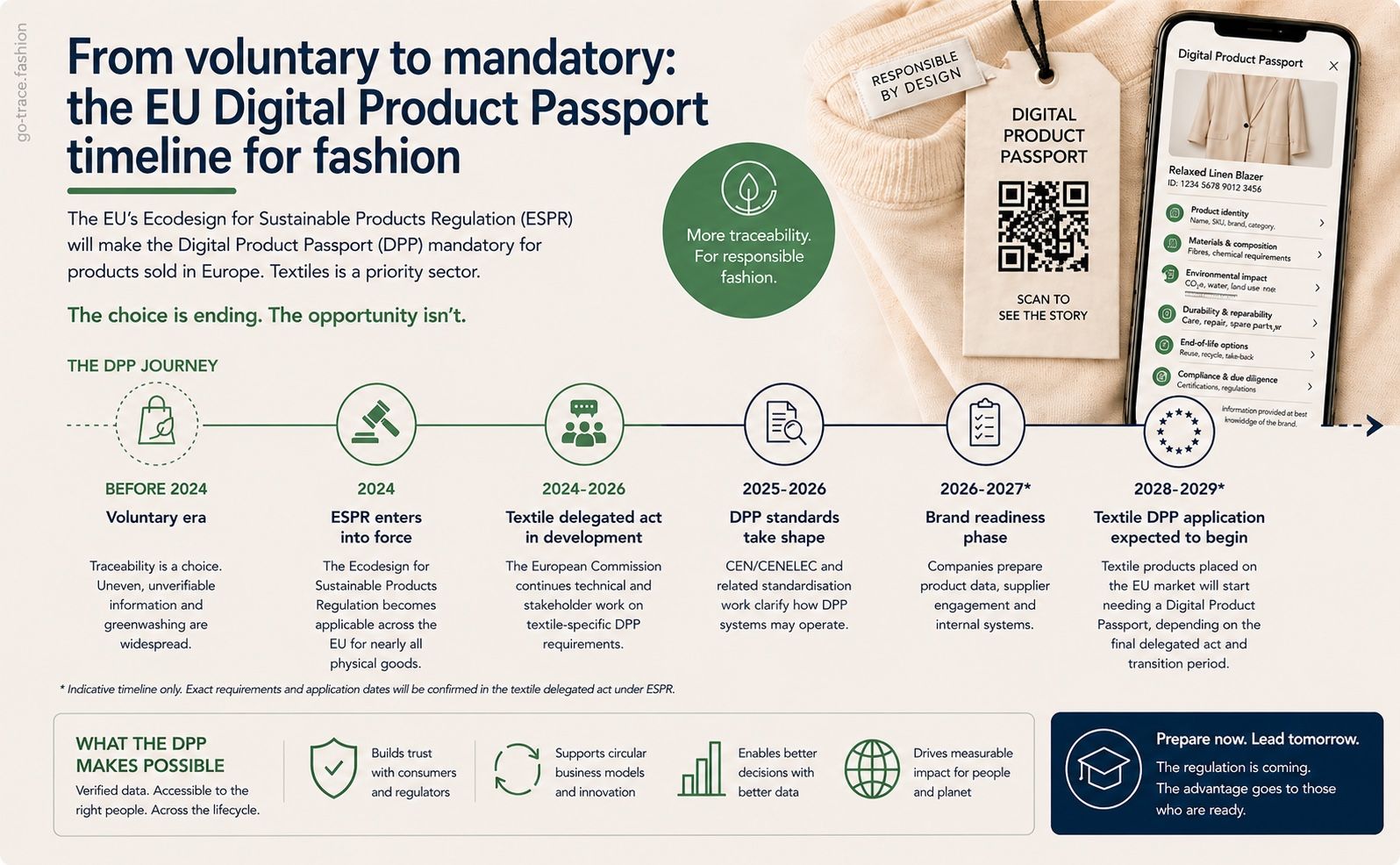
The EU’s Ecodesign for Sustainable Products Regulation (ESPR) entered into force on 18 July 2024 and introduces the legal framework through which Digital Product Passports (DPPs) will be developed for products placed on the EU market. Textiles have already been identified as a priority product group in the Commission’s 2025–2030 ESPR working plan, which means the sector is moving closer to product-specific requirements in the years ahead.
What a small group of brands championed voluntarily is becoming law. This article sets out what ESPR and the DPP are, why textiles is being prioritised, and what fashion teams should be doing now to prepare.
The voluntary era: why it’s ending
For most of the last decade, traceability in fashion was a story of self-selection. Brands that cared invested; brands that didn’t, didn’t. The information reaching consumers was uneven, often unverifiable, and sometimes actively misleading. Greenwashing was widespread because there was no common standard against which claims could be tested.
What the EU has done with the ESPR is remove that optionality. Rather than leaving disclosure largely to brand choice, it creates a framework under which product-specific requirements can be defined by law, including how certain information should be made available in digital form.
What the ESPR actually is
The Ecodesign for Sustainable Products Regulation is the successor to the older Ecodesign Directive, which historically covered energy-related products. The ESPR widens its scope dramatically: it applies to nearly all physical goods placed on the EU market, and it empowers the European Commission to set product-specific sustainability and information requirements through delegated acts.
The Digital Product Passport is the primary mechanism through which those information requirements will be delivered. In simple terms, it is a structured digital record linked to a product, typically through a data carrier such as a QR code, that can make relevant information available to different actors across the value chain.
Crucially, the DPP is not a single document. It is a framework. The exact fields, data granularity, and access rules will differ product by product, set out in the delegated acts that follow the regulation.
Why textiles was prioritised
The European Green Deal’s Circular Economy Action Plan (CEAP) identified textiles as one of the sectors where circular-economy interventions would deliver the greatest impact. The reasons are well documented: the industry’s high material throughput, low reuse and recycling rates, the volume of textile waste entering landfill and incineration, and the environmental footprint of the supply chains that produce clothing.
That prioritisation has translated into concrete regulatory attention. In its 2025–2030 ESPR working plan, the European Commission identified textiles, with apparel among the first areas of focus, as a priority product group for future ecodesign requirements. Brands that familiarise themselves with the framework now (and begin preparing their data, their suppliers, and their internal processes) will be the ones leading when it becomes mandatory, rather than scrambling.
The Digital Product Passport in practice
For the textile sector, the future DPP is likely to draw on several broad categories of product information. These may include product identification details, composition-related information, durability and circularity-relevant data, and other information linked to regulatory compliance or value-chain transparency.
However, the exact fields, formats and access conditions for textiles are still to be defined in the relevant delegated act and technical specifications. It is not enough to hold the information internally. It has to be discoverable at the product level by anyone with the right to see it.
Where we are on the timeline
The ESPR entered into force on 18 July 2024, and the Commission’s first ESPR working plan (April 2025) confirmed textiles and apparel among the priority product groups. The next milestone is the textile delegated act: the legal text that will set out the specific requirements for textiles. Current expectations point to its adoption around 2027. Once adopted, the ESPR provides a transition period of at least 18 months before the requirements apply, which places the first mandatory textile DPPs around 2028–2029 on current expectations.
Those dates can still shift, delegated acts have slipped before, and the precise scope will only be certain when the text is adopted. What will not shift is the direction: the framework is in force, textiles is named as a priority, and the implementation machinery (the JRC preparatory studies, the Ecodesign Forum, the standardisation work) is running.
For brands, the key question is no longer whether this shift is coming, but how much time they will leave themselves to prepare for it. Waiting for full clarity before acting is a strategy that leaves very little runway. The underlying data work (mapping your supply chain, identifying information gaps, negotiating data-sharing terms with suppliers) takes months or years, not weeks.
The longer horizon: 2027, 2030, 2033
It is also worth knowing that the first DPP you publish is unlikely to be the last. A 2024 study prepared for the European Parliament’s STOA panel (Digital product passport for the textile sector, EPRS) proposes deployment in three phases: a ‘minimal and simplified DPP’ on a short-term horizon of 2027, an ‘advanced DPP’, progressively extended to more stakeholders and more information, on a mid-term horizon of 2030, and a ‘full circular DPP’ supporting circular business models on a long-term horizon of 2033.
These phases are a study’s proposal, not adopted law. But they are a credible signal of where the framework is heading, and they carry a practical design lesson: whatever you build for the first compliance deadline should be architected to grow, in data depth, in audiences, and in the circular services it can support, rather than treated as a one-off compliance artefact.
What this means for brands
Three shifts are worth naming.
First, compliance is becoming a data problem. The challenge is less about making sustainability claims and more about being able to back them up with structured, traceable data that your systems, and your suppliers’ systems, can produce reliably.
Second, suppliers are now part of the compliance perimeter. You cannot produce a DPP without information from the tiers below you. That means relationships, contracts, and data exchanges need to evolve.
Third, transparency stops being a marketing asset. When information is mandatory and standardised, the differentiator moves from whether you disclose to how well your product performs on the disclosed metrics.
How to prepare
Preparation is not a single project. It is a set of parallel tracks:
- Understand the framework. Read the ESPR. Follow the delegated acts as they emerge. Track the CIRPASS initiative and the UN/CEFACT work on textile traceability.
- Audit your current data. What do you already hold? Where are the gaps? What is verified and what is asserted?
- Engage your supply chain. The data you’ll need lives with your suppliers. Start the conversation early.
- Choose technology cautiously. There are many DPP platforms competing for attention. Interoperability with emerging EU data-space standards matters more than feature breadth.
- Build internal capability. DPP readiness cuts across sustainability, product development, sourcing, legal, and IT. It is not a job for any single function.
Frequently asked questions
When will the Digital Product Passport become mandatory for textiles? No date is fixed in law yet. The textile delegated act is currently expected around 2027; with the ESPR’s minimum 18-month transition period, the first mandatory textile DPPs are expected around 2028–2029. The dates can shift: the direction will not.
Is the DPP already required today? No. The ESPR is in force, but the textile-specific requirements arrive with the delegated act. Today’s DPP initiatives are voluntary, and they are how leading brands are de-risking the mandatory phase.
What should a fashion brand do first? Map the product data you already hold against what official EU sources indicate the DPP is likely to require, identify the gaps, and start the supplier conversations early: the data work takes months or years, not weeks. Our free DPP Data Map for Textiles sets out those official sources; the DPP Readiness Assessment turns the gap analysis into a structured, personalised report.
Our mission at GO TRACE has not changed: more traceability, for responsible fashion. What has changed is that the law is catching up with what we have always believed. We built the Master Digital Product Passports for Fashion & Textiles course precisely to help fashion professionals turn this shift from an obligation into an advantage, with a clear view of the regulation, the data, the supply chain, and the technology choices ahead.
For the underlying official EU sources on textile DPP data requirements, also see our free editorial The DPP Data Map for Textiles: Built on seven official EU Commission sources.